
Last updated on February 10th, 2026 at 12:16 pm
Why Pharmaceutical Powder Blending is Critical for Drug Safety
Pharmaceutical powder blending is the critical process of mixing active pharmaceutical ingredients (APIs) with excipients to create uniform drug formulations. This step is essential for ensuring every dose is accurate, safe, and therapeutically effective.
Key aspects include achieving blend uniformity, adhering to cGMP compliance, proper equipment selection, and rigorous process validation and quality control.
The stakes are uniquely high, as blending often involves mixing potent APIs (as little as 1-2% by weight) with large amounts of excipients. As one expert notes, “Product homogeneity is extremely important due to the small scale of powder used per dose, and the health and financial implications of not achieving sufficient uniformity.”
Poor blending can lead to severe consequences, including patient harm from incorrect dosing, regulatory penalties, product recalls, and compromised drug effectiveness. Success in this field demands deep process expertise and the right equipment to manage complex powder properties and stringent requirements.
The High-Stakes World of Pharmaceutical Powder Blending
In pharmaceutical powder blending, the stakes are incredibly high. The core challenge is evenly mixing a tiny amount of active pharmaceutical ingredient (API)—often less than 2% of the total weight—into a large volume of excipients. Every dose must be identical to ensure patient safety and drug efficacy.
This precision is enforced by stringent regulatory requirements, including the FDA’s Current Good Manufacturing Practices (cGMP). Failure to achieve blend uniformity can result in ineffective or dangerously potent doses. As experts in the field note, blend uniformity is crucial for ensuring accurate dosages and maintaining the stability of pharmaceutical products.
The Critical Role of Excipients
Excipients, the so-called “inactive” ingredients, are vital to the blending process. Successful excipient selection depends on understanding powder characteristics like particle size, shape, and density. These properties determine how well materials mix. For instance, cohesive powders (sticky) and free-flowing powders (smooth) behave differently, creating a significant impact on homogeneity. At PK Blenders, we know that understanding these material interactions is as crucial as the equipment itself.
Why Pharmaceutical Powder Blending Differs from Other Industries
Unlike other industries, pharmaceutical blending is defined by several unique factors:
- Patient Safety: The primary driver is preventing harm from incorrect dosing.
- Precise Dosage: Distributing minuscule amounts of API requires specialized techniques.
- Regulatory Penalties: Non-compliance can lead to recalls, fines, and production shutdowns.
- Bioavailability & Stability: Blending affects how the drug is absorbed and its shelf life.
These factors demand a level of precision and validation far beyond standard industrial mixing.
Achieving Homogeneity: Key Factors and Equipment Selection
Achieving homogeneity in pharmaceutical powder blending requires understanding how different powders interact. Success depends on three key mixing mechanisms:
- Convective mixing: Large-scale movement of powder groups, driven by the blender’s design.
- Diffusive mixing: Small-scale, random motion of individual particles, crucial for fine-scale uniformity.
- Shear mixing: Layers of particles slide past each other, breaking up clumps.
Choosing the right equipment to facilitate these mechanisms is critical, which is why we created a guide on Choosing the Right Blender or Dryer for Your Processing Needs.
Types of Blending Equipment for Pharmaceutical Applications
Matching the blender to your powder’s properties—size, shape, and density—is key.
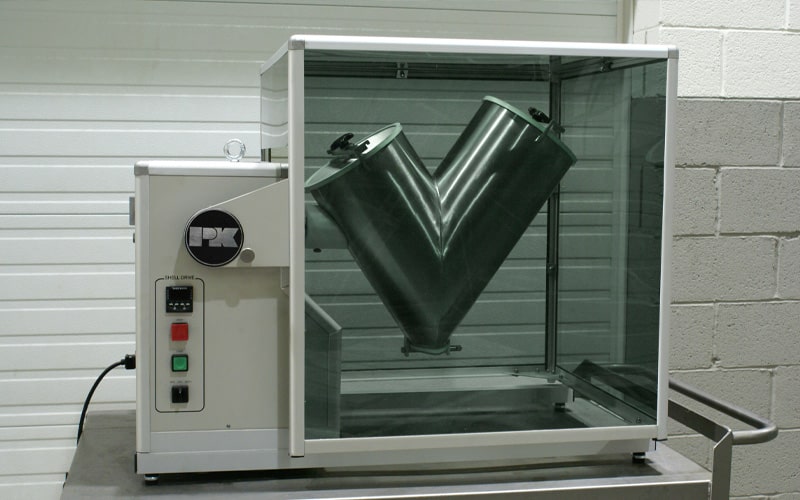
- Tumble Blenders: These gently rotate a vessel, making them ideal for fragile particles. Our Twin Shell V blenders use a V-shape for continuous splitting and recombining, while Double Cone blenders excel with materials of different densities. The Slant Cone Shell blender offers a versatile action combining convective and diffusive mixing.
- Convective Blenders: These use internal agitators for more aggressive and rapid mixing, effective for cohesive materials. Our Cross Flow blender is an innovative example of this technology.
Optimizing Mixing Dynamics and Efficiency
Proper setup is as important as the blender itself. Key operational factors include:
- Blender Geometry: The shape dictates flow patterns and prevents unmixed “dead zones.”
- Fill Level: Over- or under-filling hinders particle movement. An experimental study on fill level shows its dramatic effect on blending.
- Loading Order: The sequence of adding ingredients can significantly improve mixing efficiency.
- Blending Time & Rotational Speed: These must be optimized to achieve uniformity without causing segregation or particle damage.
Optimizing these factors is a science we’ve perfected, as detailed in Why PK Blenders are a Game Changer in Precision Mixing. Our testing lab helps fine-tune these parameters for every formulation.
Upholding Quality: cGMP, Validation, and Process Control
In pharmaceutical powder blending, quality is built into every step, not just inspected at the end. This is governed by current Good Manufacturing Practices (cGMP), mandatory standards that ensure product safety and consistency.
Key quality pillars include:
- Cleanliness Standards: Preventing cross-contamination is critical to avoid life-threatening errors. Comprehensive, validated cleaning protocols are essential between batches.
- Microbiological Control: Blends must remain free from harmful microorganisms, requiring strict sanitation of all product-contact surfaces.
- Validation: Equipment qualification (EQ) confirms blenders are installed and operate correctly, while process validation proves the entire blending process reliably produces a quality product.
The Role of Advanced Technology in Pharmaceutical Powder Blending
Modern blending relies on Process Analytical Technology (PAT) for real-time insights, shifting from reactive to proactive quality control.
Near-infrared (NIR) spectroscopy is a key PAT tool. Instead of disruptive thief sampling, NIR probes continuously monitor blend composition inside the blender. By analyzing how compounds absorb light, NIR provides accurate, real-time data on the concentration of APIs and excipients.
Research on Monitoring powder blending with NIR spectroscopy highlights the benefits of multiprobe measurement systems, which offer a complete picture of homogeneity throughout the vessel. This technology enables precise end-point detection, identifying the exact moment a blend is uniform, and facilitates closed-loop control in continuous manufacturing, where the system automatically adjusts to maintain quality.
Overcoming Common Problems: Managing Segregation and Agglomeration
Two persistent challenges in pharmaceutical powder blending can undermine uniformity: segregation and agglomeration.
Segregation (demixing) is the separation of particles after mixing, often due to differences in particle size, shape, or density. Smaller, denser particles can sift through larger ones (percolation), especially during transport or due to vibration. This can ruin a perfectly good blend.
Agglomeration is the opposite problem, where fine, cohesive powders stick together due to inter-particle forces (e.g., static, moisture). This creates clumps or “hot spots” with high API concentration, compromising dose uniformity. Research into controlling cohesive particle mixing and segregation highlights the complexity of these phenomena.
Effective Management Strategies
Managing these issues requires a strategic approach combining process optimization, material science, and the right equipment.
| Issue | Causes | Effective Management Strategies |
|---|---|---|
| Segregation | Particle size/density differences, percolation, vibration during transport, improper handling | Minimizing transport time after blending, implementing proper handling procedures, matching particle sizes through milling or sieving, optimizing blender fill levels and mixing times |
| Agglomeration | Cohesive powders, inter-particle forces, moisture, electrostatic charges, fine particle sizes | Applying controlled shear to break up clumps, strategic excipient selection to improve flow, controlling environmental conditions (humidity, temperature), using anti-static measures |
Key tactics include minimizing transport time post-blending, using controlled shear to break up agglomerates without damaging particles, and making smart excipient choices to improve flow. Often, the best solution is a custom combination of these strategies custom to the specific formulation.
Introduction
Pharmaceutical powder blending is the critical process of mixing active pharmaceutical ingredients (APIs) with excipients to create uniform drug formulations. This step is essential for ensuring every dose is accurate, safe, and therapeutically effective.
Key aspects of pharmaceutical powder blending:
- Blend uniformity – Even distribution of APIs throughout the mixture
- cGMP compliance – Meeting strict regulatory manufacturing standards
- Equipment selection – Choosing the right blender for specific powder properties
- Process validation – Documenting consistent, repeatable results
- Quality control – Testing samples to verify homogeneity and purity
The stakes in pharmaceutical blending are uniquely high. As one industry expert notes, “Product homogeneity is extremely important due to the small scale of powder used per dose, and the health and financial implications of not achieving sufficient uniformity.”
Poor blending can lead to severe consequences, including patient harm from incorrect dosing, regulatory penalties, product recalls, and compromised drug effectiveness. Success in this field demands deep process expertise and the right equipment to manage complex powder properties and stringent requirements.
The High-Stakes World of Pharmaceutical Powder Blending
In the pharmaceutical world, precision is a matter of health. Pharmaceutical powder blending ensures every dose of medication is consistent and safe. The primary challenge is distributing a tiny amount of active pharmaceutical ingredient (API), often less than 1-2% of the blend weight, perfectly throughout a much larger volume of excipients.
The stakes are immense. Non-uniform blends can lead to dangerous or ineffective doses. This is why the process is governed by stringent regulatory requirements like current Good Manufacturing Practices (cGMP). Poor blend uniformity compromises dosing, stability, and bioavailability.
The Critical Role of Excipients
Excipients are foundational to drug formulation. Their physical properties—particle size, shape, density, and flow properties—are critical. Cohesive (sticky) fine particles and free-flowing coarse particles present engineering challenges, as differences in these properties can cause segregation (demixing). At PK Blenders, our work in pharmaceuticals centers on mastering these material interactions to create stable, uniform products.
Why Pharmaceutical Powder Blending Differs from Other Industries
Pharmaceutical blending is unique due to:
- Patient Safety: The absolute priority is accurate dosing to prevent patient harm.
- Regulatory Environment: Strict cGMP standards demand rigorous validation and control.
- Low-Dose Potency: Mixing minute API quantities requires specialized equipment and techniques.
- Bioavailability and Stability: Blending directly impacts how the drug is absorbed and its shelf life.
These factors, combined with high economic stakes, make pharmaceutical blending a specialized scientific discipline.
Achieving Homogeneity: Key Factors and Equipment Selection
Achieving perfect homogeneity in pharmaceutical powder blending is a science that balances powder properties, blending mechanisms, and equipment selection. The three primary blending mechanisms are:
- Convective mixing: Large-scale movement of particle groups.
- Diffusive mixing: Individual particle rearrangement for fine-scale uniformity.
- Shear mixing: Layers of particles slide past one another, breaking up clumps.
Choosing the right equipment is critical, as we explore in our guide on Choosing the Right Blender or Dryer for Your Processing Needs.
Types of Blending Equipment for Pharmaceutical Applications
The right blender matches your powder’s unique characteristics.
- Tumble Blenders: These gently rotate a vessel, ideal for fragile materials. Our Twin Shell V Blenders use a V-shape for efficient mixing, while Double Cone Blenders handle varied densities well. Slant Cone Shell Blenders offer versatile mixing action.
- Convective Blenders: Using internal agitators, these are faster and more effective for cohesive powders. Our Cross Flow blenders are an innovative example.
Optimizing Mixing Dynamics and Efficiency
Optimal results depend on several operational parameters:
- Blender Geometry: A well-designed shape ensures consistent particle movement and prevents dead zones.
- Fill Level: Incorrect fill levels can create stagnant zones and hinder mixing. An experimental study on fill level provides valuable insights into this phenomenon.
- Loading Order: The sequence of adding ingredients can significantly improve uniformity.
- Blending Time & Rotational Speed: These must be carefully balanced to achieve homogeneity without causing demixing or particle damage.
As we discuss in Why PK Blenders are a Game Changer in Precision Mixing, our lab can fine-tune these parameters for any formulation.
Upholding Quality: cGMP, Validation, and Process Control
Quality in pharmaceutical powder blending is non-negotiable. It is built on a foundation of current Good Manufacturing Practices (cGMP), rigorous cleanliness standards, and robust process controls.
cGMP regulations mandate meticulous control at every step to guarantee uniformity and safety. This is proven through validation.
- Cleanliness Standards: To prevent cross-contamination—a potential patient safety crisis—multi-level, validated cleaning programs are essential. This includes microbiological control to ensure sterility.
- Validation: Equipment qualification (EQ) (IQ, OQ, PQ) confirms the blender is installed and performs correctly. Process validation then proves the entire process consistently produces a quality product.
The Role of Advanced Technology in Pharmaceutical Powder Blending
Process Analytical Technology (PAT) has revolutionized blending by enabling proactive quality assurance. The most powerful PAT tool is Near-Infrared (NIR) spectroscopy.
Instead of disruptive, time-consuming lab sampling, NIR probes continuously measure blend composition in real-time inside the blender. This provides a live view of homogeneity. While single probes have limits, multiprobe NIR systems offer a comprehensive, spatially resolved picture of component distribution.
This real-time data enables:
- End-point detection: Precisely identifying when the blend reaches optimal homogeneity, preventing under- or over-mixing.
- Closed-loop control: In continuous processes, the system can automatically adjust to maintain quality.
As research like Monitoring powder blending with NIR spectroscopy shows, this technology makes blending more efficient, reliable, and compliant.
Overcoming Common Problems: Managing Segregation and Agglomeration
Two persistent challenges in pharmaceutical powder blending are segregation and agglomeration, which can ruin blend uniformity.
Segregation (demixing) is the separation of particles after mixing. It’s often caused by differences in particle density, size, or shape. Mechanisms like percolation (small particles sifting downward) and vibration during transport can cause denser particles to settle, undoing the mix.
Agglomeration is when fine particles stick together due to inter-particle forces (e.g., static, moisture), forming clumps. This creates “hot spots” of high API concentration and “cold spots” with too little, leading to inconsistent dosing. Research on Controlling cohesive particle mixing and segregation explores these complex behaviors.
Effective Management Strategies
Managing these issues requires a strategic approach that addresses the root causes.
| Issue | Causes | Effective Management Strategies |
|---|---|---|
| Segregation | Particle size differences, density variations, vibration during transport | Minimize transport time between blending and downstream processing; implement proper handling procedures with gentle transfers; consider particle size matching through controlled milling or granulation |
| Agglomeration | Cohesive fine powders, inter-particle forces, moisture, electrostatic charges | Apply controlled shear during blending to break up clusters; use pre-blending techniques like sieving; optimize excipient selection to improve flow properties |
Key strategies include minimizing transport time, using proper handling procedures, applying controlled shear to break up clumps, and making smart excipient choices. Since every formulation is unique, the best approach often combines several of these tactics, custom to your specific materials.